
Sea Horses in the Ocean
Artist
Aogaoka Keisei
(Japanese, active ca. 1818–1835)
Datecommissioned for New Year 1820, Year of the Dragon
MediumColor woodblock print
Dimensions8 1/8 × 7 1/16 inches (20.6 × 17.9 cm)
ClassificationsPrints
Credit LineGift of Joanna Haab Schoff, Class of 1955
Terms
- Japanese
- Surimono
- Color woodblock print
- Poetry
- Water
- Seahorses
- Waves
- Sun
Object number2011.017.022
Label CopyOsamareru The well-ruled imperial realm
Miyo wa yutaka ni Rests in comfort
Nami no shiwa mo Legs of spring sunbeams
Uchi no hashitaru Run gently over
Haru no hi no ashi Wrinkles of waves
—Cho ¯cho ¯tei Somabito
Osamareru Well ruled, this imperial realm
Miyo zo nodokeki Is peacefully quiet
Hi no kage mo The rays of the sun
Shikai no nami mo And the waves of the four seas
Yutani tatsu haru At ease as the dragon spring opens
—Senzaitei Matsuna
This image of seahorses, drifting free of care in the ocean waves, is the very epitome of the ideals of ease and peacefulness associated with the New Year season. The assertion that “all is well under the sun,” here the rising sun of the New Year dawn, was not only a private wish, but in Japanese poetry (waka) has long had political connotations, implying a well-ruled realm. The sea horses floating in the water, for example, much resemble dragons, emblematic of the celestial forces underlying nature, which work properly when the world is in balance, and the connection with the Year of the Dragon (1820) is confirmed in the final line of the second verse, which could mean either “spring stands [begins]” or “dragon spring.”
The poems, like the image, both emphasize peace and gentleness. The connection between peace and good politics is brought to the surface in both poems with the phrase miyo, a classical poetic term referring to the imperial reign. Praise of the emperor was one traditional aspect of New Year verse, and the earliest model for surimono may be found in the New Year kissho, felicitous writings ritually presented to the emperor at the New Year. One way of challenging the authority of the Tokugawa shogunate was to raise the emperor as an alternate and deserving source of fealty, so these seemingly anachronistic throwbacks to classical verse may well have had a subversive political message.
Collections
Utagawa Toyohiro
ca. early 1810s
Katsushika Hokusai
commissioned for New Year 1822, Year of the Horse
Katsushika Hokusai
1864
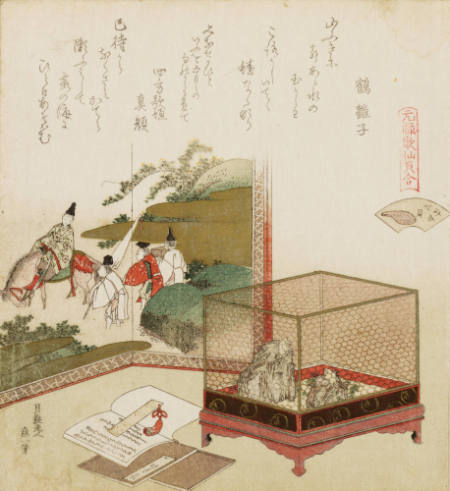
The Waterless Shell (Minase-gai), from the series: The Poetry-Shell Matching Game of the Genroku Era
Katsushika Hokusai
commissioned for New Year 1821
Harukawa Goshichi
commissioned for a New Year, likely before 1818
Utagawa Kunisada (Toyokuni III)
commissioned for New Year 1834, Year of the Horse
Katsushika Hokusai