

The Three Laughers of the Tiger Ravine
Artist
Keisai Eisen
(Japanese, 1790–1848)
Datecommissioned for New Year 1830, Year of the Tiger
MediumColor woodblock print
Dimensions8 3/8 × 7 1/16 inches (21.3 × 17.9 cm)
ClassificationsPrints
Credit LineGift of Joanna Haab Schoff, Class of 1955
Terms
- Japanese
- Surimono
- Color woodblock print
- Women
- Bridges
- Streams
- Poetry
Object number2011.017.027
Label CopyTora no sumu
Iwa no to mo kesa
Ake no kata
Ehou to tsugeru
Uguisu no koe
Even the boulder door
Where the tiger dwells
Opens with this morning’s light
As the voice of the warbler informs us
Of the fortunate direction
—Kajuan Fukumaro
Itadori ya
Warabi uru shizu mo
Yamagatsu mo
Ume no kaori mo
Warau harukaze
The women selling
Bracken and “tiger cane,”
The mountain folk,
And the scent of plum, too
All laughing in the spring breeze
—Kicho ¯do ¯
The source for this surimono is a pseudo-historical Chinese legend. Three famous literati of the fourth-fifth century met one afternoon: the poet Tao Yuanming and the Taoist Lu Xiujing travel to visit Buddhist scholar Huiyuan at his temple. Huiyuan has taken a strict vow of seclusion, and is not permitted to go onto the bridge over the Tiger Ravine, marking the limit of Donglun Temple. While seeing his friends off, Huiyuan becomes so engrossed in conversation that he does not realize, until it is too late, that he is crossing the bridge. There is a brief moment of shock, then the three friends burst into laughter, realizing the absurdity of placing arbitrary boundaries on the human spirit, and even, according to some interpretations, the consequent limitations of artificiality in each of their belief systems.
Eisen has depicted the sages as three women crossing a stone bridge over rapids, in a mountainous space with sharp peaks distinctly unlike those of Japan. The women are quite common, contemporary types, apparently returning from a festival. The woman on the left, representing Buddhist Huiyuan, carries a bamboo branch with a festival mask of Otafuku (known, too, as Okame), goddess of bliss; she is also identified with the goddess Uzume, whose dance drew Amaterasu from her cave, as mentioned in the first verse. Next to her is the stand-in for the Confucian Tao Yuanming, holding a patterned tanzaku card such as poets employed for inscriptions. On the right is the representation of Lu Xiujing, holding one of the mountain vegetable plants (zenmae) mentioned in the verse and often associated with natural mysteries (hence Taoism).
Collections
Keisai Eisen

Keisai Eisen

Keisai Eisen

Utagawa Toyohiro
ca. early 1810s
Totoya Hokkei
commissioned for a New Year, ca. 1835
Tsukioka Kogyo
1922–1925
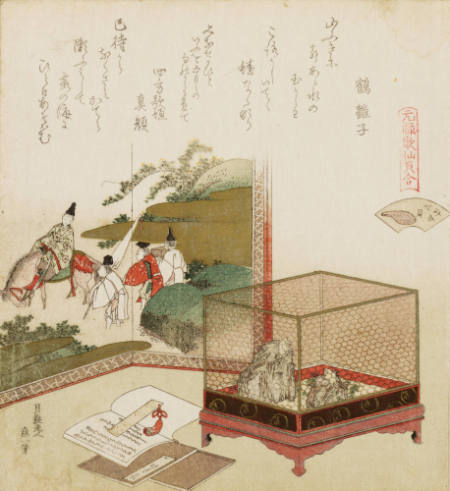
The Waterless Shell (Minase-gai), from the series: The Poetry-Shell Matching Game of the Genroku Era
Katsushika Hokusai
commissioned for New Year 1821