

A Picture Calendar for 1817, Year of the Ox
Artist
Kitao Shigemasa
(Japanese, 1739–1820)
MediumColor woodblock print
Dimensions5 5/8 × 7 3/8 inches (14.3 × 18.7 cm)
ClassificationsPrints
Credit LineGift of Joanna Haab Schoff, Class of 1955
Terms
- Japanese
- Surimono
- Color woodblock print
- Calendars
- Poetry
- Seals
- Calligraphy
Object number2011.017.007
Label CopySurimono were typically made for the New Year, either as picture calendars or as New Year’s greetings commissioned by poetry groups.
Shigemasa’s print shows an ink-paste holder with seals, and a sheet of paper showing the impressions of the seals that contain the numbers for the short months, on the left, and the long months, on the right, for the year 1817. ("American Sojourns and the Collecting of Japanese Art," curated by Ellen Avril and presented at the Johnson Museum June 25–December 18, 2016)
•
Sumi no iro The color of lampblack
Ji no gyogi yoku On the well aligned characters
Inochi made mo Sitting properly
Shanto suwari As though their lives depended on it
Chigo no kakizome The children’s first writing of the year —Asakuraan Sansho
The subject of this work is comprised of a decoratively designed inkpad holder with a red karakusa (“Chinese grass”) pattern, and two fancy, well-carved seals, impressions of which, cleverly embodying the calendar numbers for 1817, appear on the paper in the lower left corner. The seal on the right has a carving of a “petting ox,” the smooth forms of which are wonderfully captured by the woodblock embossing process. The petting ox was a small stone sculpture used as a talisman, rubbed lovingly when one had a wish to make, and rewarded with a cushion (here, the inkpad holder) when the wish came true, thus often featured as a reference to years of the ox.
The seal on the left, with rings on the top, was used as a counterweight on a string hung over the sash of a kimono, typically with a money bag at the other end. In the impressions of these seals, we find the small months for 1817 on the left (2, 5, 7, 9, 10, 12) and the large (1, 3, 4, 6, 8, 11) on the right. The poem jokingly refers to the seals as the children’s debut kakizome, or first calligraphic writing of the year, describing how disciplined and well-arranged the characters, of both letters and children, are.
Collections
Katsushika Hokusai
Katsushika Hokusai
1864
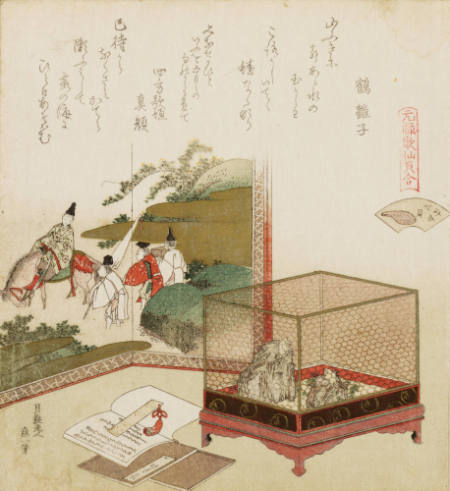
The Waterless Shell (Minase-gai), from the series: The Poetry-Shell Matching Game of the Genroku Era
Katsushika Hokusai
commissioned for New Year 1821
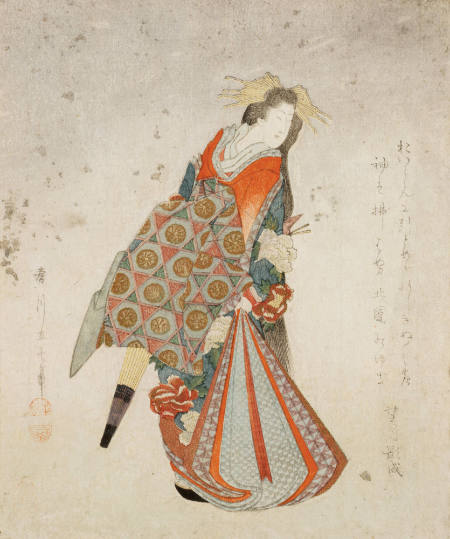
Harukawa Goshichi
commissioned for a New Year, likely before 1818
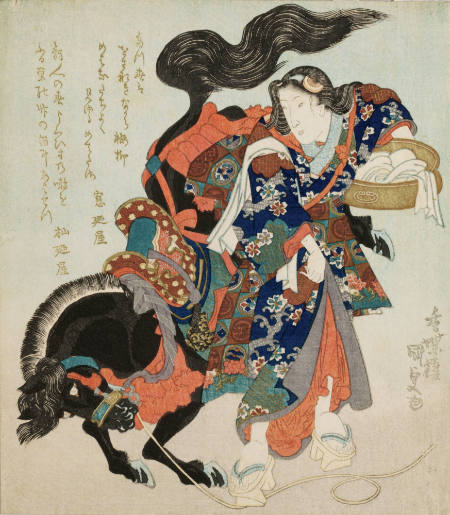
Utagawa Kunisada (Toyokuni III)
commissioned for New Year 1834, Year of the Horse