

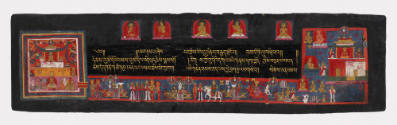

Illuminated cover and frontispiece from a Prajnaparamita manuscript
Artist
Unidentified artist
Datelate 15th century
MediumOpaque watercolors and gold on paper with silk brocade covering
DimensionsPart a (open): 14 1/4 × 28 inches (36.2 × 71.1 cm);
Part a (sheet): 7 5/8 × 28 inches (19.4 × 71.1 cm);
Part b (sheet): 7 5/16 × 27 1/16 inches (18.6 × 68.7 cm)
Part a (sheet): 7 5/8 × 28 inches (19.4 × 71.1 cm);
Part b (sheet): 7 5/16 × 27 1/16 inches (18.6 × 68.7 cm)
CultureWestern Tibet, Guge
ClassificationsManuscripts
Credit LineAcquired through the George and Mary Rockwell Fund
Terms
- Manuscripts
- Tibetan
- Opaque watercolor and gold
- Silk
- Buddhism
- Paper
Object number2006.028 a,b
Label CopyNamed for the female personification of the Perfection of Wisdom, the Prajnaparamita sutras are Mahayana Buddhism’s primary scriptures, conveying the teachings necessary for becoming a bodhisattva and achieving enlightenment. The main figures on the cover displayed here are the historical Buddha Shakyamuni, at the left, shown at the moment of his enlightenment, and the blue-skinned Vajradhara, at right. Vajradhara embodies all the Buddhist teachings and is shown crossing his hands in which he holds the vajra and the bell, symbolizing the perfect union of wisdom and compassion.
The frontispiece depicts the story of Sadaprarudita’s search for enlightenment. Instructed in a vision to go to the Gandhavati paradise of the bodhisattva Arya Dharma, Sadaprarudita is distraught that he has no gift to bring. He offers his own body to the god Indra, who has disguised himself as a young man, when a merchant’s daughter sees Sadaprarudita and is impressed by his self-sacrifice. Indra miraculously restores Sadaprarudita’s body and the merchant’s daughter vows to assist him in his journey. She persuades her parents to join them in a procession of five hundred carriages. The procession is shown here proceeding to the Gandhavati paradise at the left. (“Highlights from the Collection: 45 Years at the Johnson," curated by Stephanie Wiles and presented at the Johnson Museum January 27–July 22, 2018)
Collections
Unidentified artist
Unidentified artist
Unidentified artist
ca. 1595