
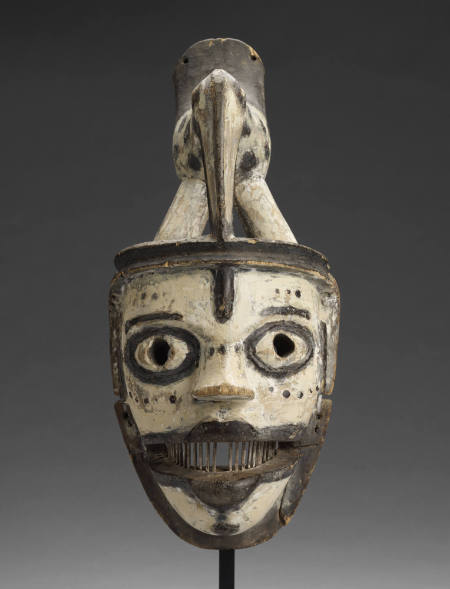
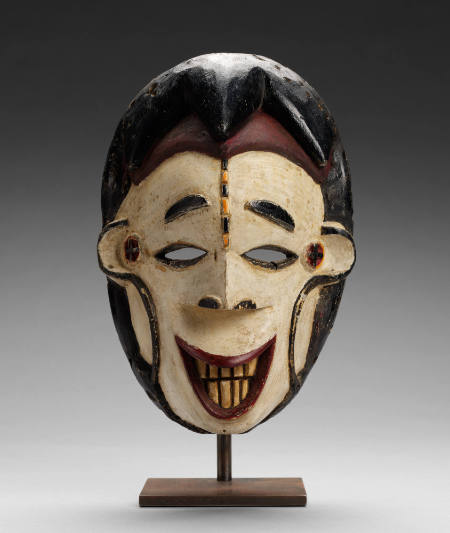
Elu face mask
Place Made DisplayWest Africa Nigeria
MediumWood and pigments
Dimensions7 3/4 × 6 × 5 inches (19.7 × 15.2 × 12.7 cm)
CultureOgoni (Nigeria)
ClassificationsCostume
Credit LineGift of Dorothy Brill Robbins, Class of 1933
Terms
- Nigeria
- Costume
- Ogoni
- wood and pigments
Object number90.057.007
Label CopyBRIEF DESCRIPTION
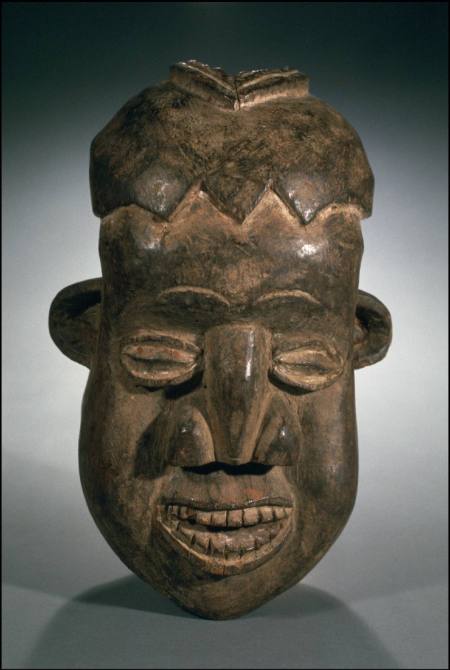
Like other Elu masks of the Ogoni, this mask depicts a benevolent spirit.
WHERE WAS IT MADE?
This mask was made by the Ogoni, who have traditionally lived on the fertile plain to the northeast of the Niger Delta in Nigeria. This area holds valuable oil deposits; consequently, the Ogoni have been forced from their homelands in recent years.
HOW WAS IT MADE?
This mask was carved from wood using hand tools such as an adze and either knives or chisels. It was painted with natural pigments.
HOW WAS IT USED?
This mask was probably used in karikpo, a masquerade performed in Ogoni communities. Karikpo included acrobatic dances and masked performances sometimes related to fertility.
WHY DOES IT LOOK LIKE THIS?
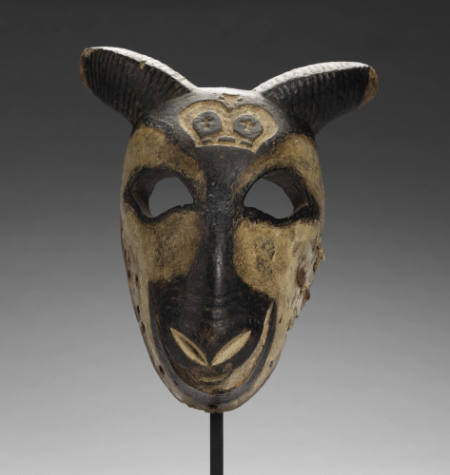
Elu masks have small, youthful faces that depict benevolent spirits. Fashionable hairstyles, wide foreheads, and small noses and eyes typify the form. Elu masks do not entirely cover the performer’s face. Masks are secured in front of the face and surrounded by brightly colored cloth or grasses.
Elu often incorporate a hinged jaw. This feature allows the wearer to manipulate the lower portion, allowing the mask to “speak” and smile, displaying its reed “teeth.” Look closely at this mask, and you will see that it has a hinged jaw. To see other elu masks in the Johnson Museum’s collection, search for object numbers 92.005.042 and 92.075.003 in the keyword search box.
Martha O’Connell ’09 conducted research for this description.
Collections
20th Century

ca. 1900-1940