
Divination tray (opon ifa)
Date20th century
Place Made DisplayAfrica; Nigeria
MediumWood
Dimensions8 x 12 1/2 inches (20.3 x 31.8 cm)
CultureNigeria, Yoruba people
ClassificationsArtifacts
Credit LineGift of William W. Brill
Terms
- Nigeria
- Artifacts
- Yoruba
- Wood
- Divination objects
- Faces
Object number88.026.022
Label CopyBRIEF DESCRIPTION
This is a divination tray used by a Yoruba diviner (called a babalawo) to seek wisdom from Orunmila, the god of wisdom and divination.
WHERE WAS IT MADE?
This was made in the southwest of Nigeria, where the Yoruba people live.
HOW WAS IT MADE?
Trays such as this one are hand carved from a piece of wood with hand tools such as an adze, knives, and chisels.
HOW WAS IT USED?
Yoruba people traditionally seek advice from diviners who in turn seek wisdom from Orunmila, the god of wisdom and divination. The spiritual world communicates with the diviner by way of the divination tray. In order to receive spiritual messages, the diviner spreads a thin layer of wood dust on the surface of the tray. The diviner gently strikes the tapper against the side of the divination board in order to call on Orunmila. (To see part of a divination tapper in the Johnson Museum’s collection, search for object number 91.001.034 in the keyword search box.) This action, along with praise chants, inaugurates the divining session. The diviner then moves around in the dust either sixteen sacred palm nuts or a divining chain. The resulting pattern is interpreted in songs and tales, which the client applies to his or her particular problem.
WHY DOES IT LOOK LIKE THIS?
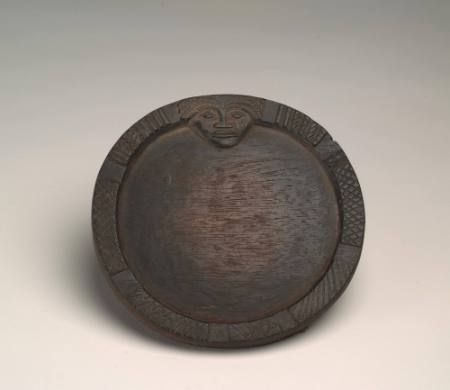
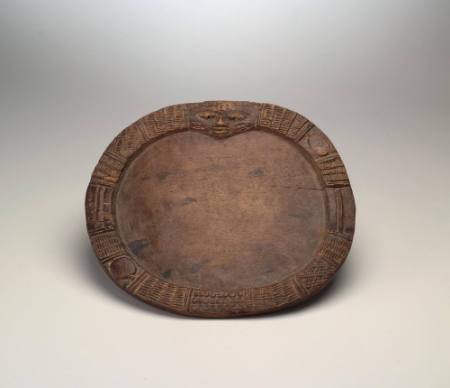
Notice the face at the top of the tray. This is typical of divination trays, and all three of the trays in the Johnson Museum’s collection have faces on them. (To see the other trays, search for object numbers 84.012.002 and 92.005.056 in the keyword search box.) Diviners have interpreted this face in different ways. Some have claimed that it is the “face of the tray” as though each tray had an individual identity. More frequently, diviners say that it is the face of Eshu Elegba, the Yoruba messenger of the gods. As the divine messenger, he mediates spiritual communication. Eshu stands at the crossroads: between the earthly and spiritual world; between men and women; and even between buyers and sellers in the marketplace.
Collections
20th century
20th century
ca. 100-700 AD