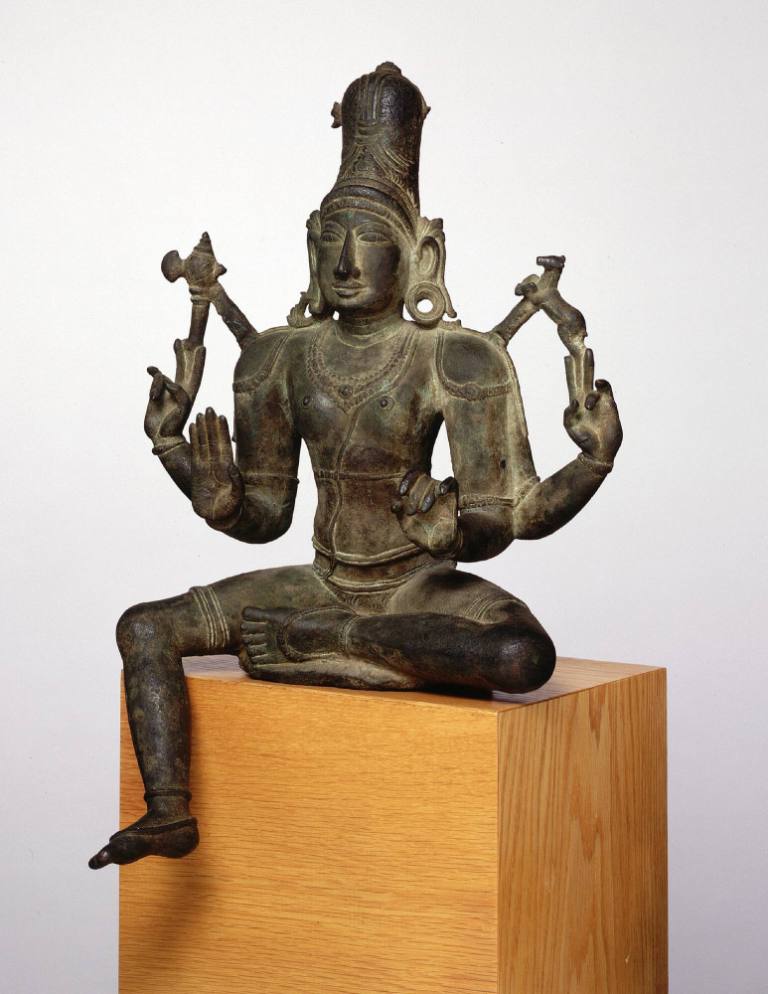
Seated Shiva
Maker
Unidentified artist
Date14th-15th century
MediumBronze
Dimensions20 3/4 x 14 inches (52.7 x 35.6 cm)
CultureIndian
ClassificationsSculpture
Credit LineMuseum Associates Purchase Fund
Terms
- Sculpture
- Indian
- Bronze
- Animals
- Axes
- Deer
- Hinduism
- Religion
- Shiva
- Siva
- Tools
Object number67.027
Label CopySouth Indian bronzes have long been regarded as one of the great achievements of the metalworker's art. With their abstract tubular limbs, elongated proportions, heart-shaped faces, and melodic gestures, these bronzes seem pervaded with a mystic gravity of spirit. Most of them were created in the service of Hinduism. The greatest period of achievement spans roughly the eighth to the twelfth centuries; our sculpture may date a century or two later, and represents the great Hindu god of creation and destruction, Shiva. He was originally seated together with his feminine consort Uma on a rectangular bronze pedestal, a common pairing in Hindu iconography. These pairs are touched with a serene and timeless domesticity, and are in polar contrast to the many other guises of Shiva as ascetic or destroyer. It is these contradictions between diametrically opposed conditions and qualities that make the mythology of Shiva so enigmatic. He is at once the fountain of eroticism and the desert of asceticism, and his mythology enacts a world process based on the dynamic interpenetration and permutation of desire and withdrawal, becoming and dissolution, terror and joy. In South India, Shiva is usually represented, as here, carrying in his upper hands an axe and a deer. According to the legend of the Pine Tree Forest, Shiva seduced, or created the impression that he seduced, the wives of a group of ascetic sages. The angry sages attacked Shiva by throwing a hatchet that he caught and now holds in his right hand. They then sent an antelope against him, which he captured in his left hand. (From “A Handbook of the Collection: Herbert F. Johnson Museum of Art," 1998)Collections
ca. 300-1 B.C.
AD 1200-1470

600–900 CE