

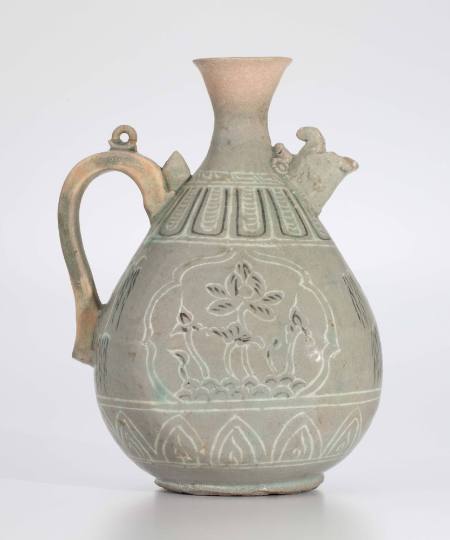
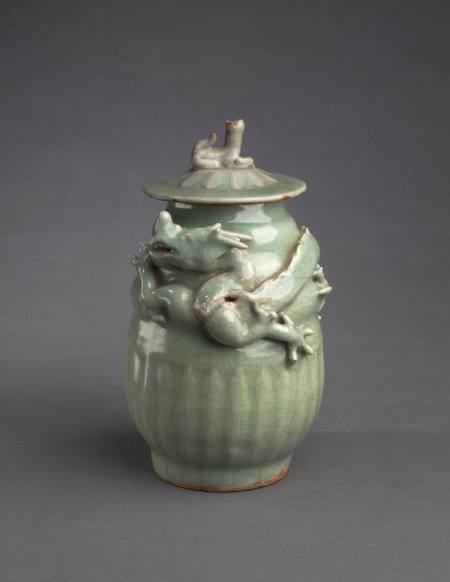
Ewer
Maker
Unidentified artist
MediumCeladon ware
DimensionsHeight: 7 inches (17.8 cm)
CultureKorea
ClassificationsCeramics
Credit LineGift of Colonel John R. Fox
Terms
- Ceramics
- Vessels - Ewers
- Korean
- Celadon ware
- Animals
- Birds
- Flowers
- Mythological creatures
- Lotuses
- Phoenixes
- Plant-derived motifs
Object number65.317
Label CopyBRIEF DESCRIPTION
This is an early Korean ceramic vessel once used to hold food or drink.
WHERE WAS IT MADE?
This vessel was made in an area of southeastern Korea once ruled by the Silla kingdom.
HOW WAS IT MADE?
This vessel shows signs of having been made on a potter’s wheel. The potter’s wheel was brought to Korea from China more than 2000 years ago. A closed type of kiln was also introduced from China around the same time. These kilns could reach higher temperatures than the open kilns that Korean potters had used previously. Ashes that accidentally adhered to the surface of the vessel during the firing process were converted to a type of glaze by the high temperatures in the kiln.
HOW WAS IT USED?
During the Three Kingdoms period (ca. 300-668) ceramic vessels such as this one were made for everyday use and for burial in tombs. Large quantities of these vessels have been excavated from tombs, where they were interred after being used during funerary rituals. To supply the deceased in the after-life, vessels were typically filled with food and drink at the time of the burial. This particular vessel was likely used as a cup or jar.
WHY DOES IT LOOK LIKE THIS?
Blackish-gray stoneware predominated during the Three Kingdoms period, some with ash glazes that occurred naturally during high temperature firing, when flying ash settled on and fused to the pot. Pedestal pots and jars, like this one, were the most common vessel form of the time. They were primarily decorated with pierced geometric forms around the pedestals and incised motifs on the vessel surfaces. Notice the wave-like pattern circling the two lower sections on the upper part of this vessel.
To see other pedestal jars in the Johnson Museum’s collection, search for object numbers 65.335, 80.051.003, 86.078.004, 88.021.008, 88.021.010, 97.032.027, and 97.032.029 in the keyword search box.
Collections
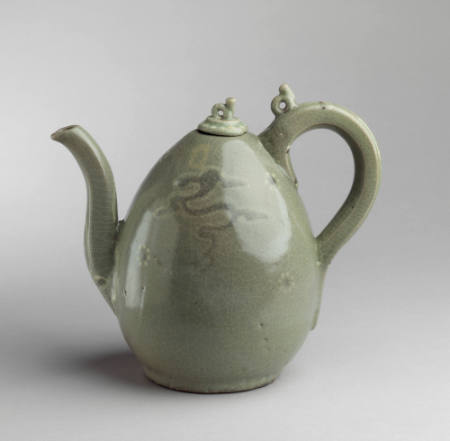
12th century
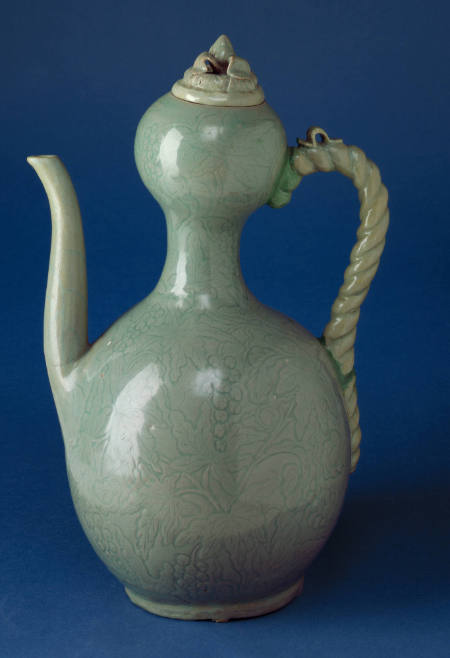

Unidentified artist

Unidentified artist
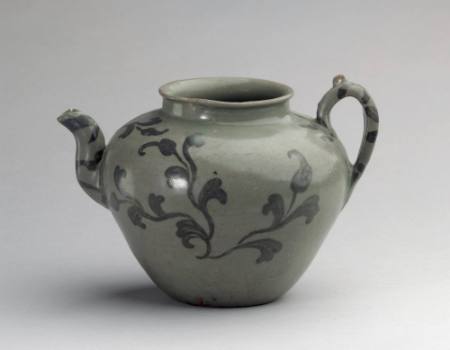

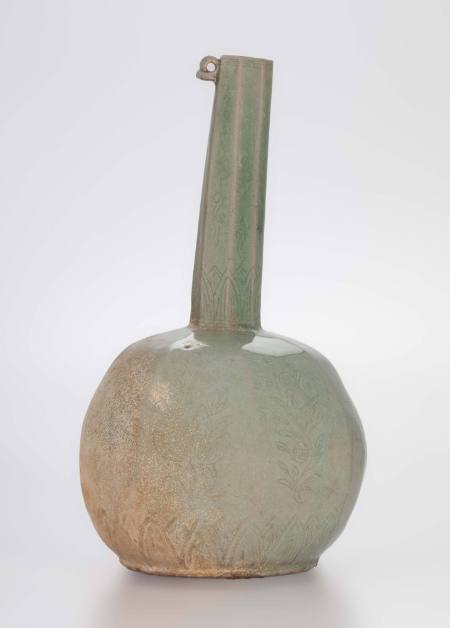
AD 1470-1532
20th century
12th or 13th century