

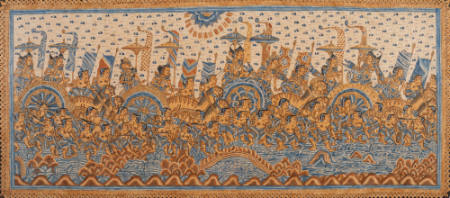
Scene from the Mahabharata
Artist
Workshop of Mangku Mura
(Bali, Kamasan, active in the 20th century)
Dateca. 1970s or 80s
MediumInk and natural pigments on cloth
DimensionsApprox.: 33 × 72 inches (83.8 × 182.9 cm)
ClassificationsPaintings
Credit LineGift of Heimun Miksic and John Norman Miksic, MA 1976, PhD 1979
Terms
- Paintings
- Indonesian
Object number2026.017.009
Label CopyPerhaps purchased directly from Mangku Mura’s home and workshop in Kamasan, this diptych reveals the long procession described in the Bharatayuddha, a Javanese poetic adaptation (kakawin) written by Mpu Sedah and Mpu Panuluh in the twelfth century. The paintings present the orderly “quiet before the storm” leading to the final battlefield of the Kurukshetra War as chronicled in the Mahabharata, just before this climactic eighteen-day conflict between the Pandawas and the Korawas has occurred.
Here, Bima, in his chariot, leads his soldiers. Then come the loyal clowns (punakawan), Twalen and Mredah, and the god Indra (Arjuna’s father) in his nimbus, who, according to the Bharatyuddha text, “led them to the sky.” In the next chariot is Arjuna, followed by his brothers, the twins, Nakula and Sadewa in their chariot. They are accompanied on foot by the three sons of Wirata: Sweta, the commander in chief; then Uttara and Shanka. Next come Srikandi and Drastadyumna in their chariot, followed by Dropadi, the wife of the five Pandawa brothers with her principal husband, Yudistira, carrying his palm leaf manuscript. Bringing up the rear is Krishna, who will serve as Arjuna’s adviser and charioteer in the Great Battle.
Depicting the procession in blue waters emphasizes the sea-related imagery invoked in the story. In the sea of blood to which the battlefield is compared, the hair of fallen warriors is likened to seaweed, and the elephants and horses are said to resemble rocks on which the bristling arrows are compared to the roots of the pandan tree.
Collections


Unidentified artist
19th century
ca. 18th or early 19th century
Unidentified artist
19th century
Unidentified artist
ca. 1890–1910