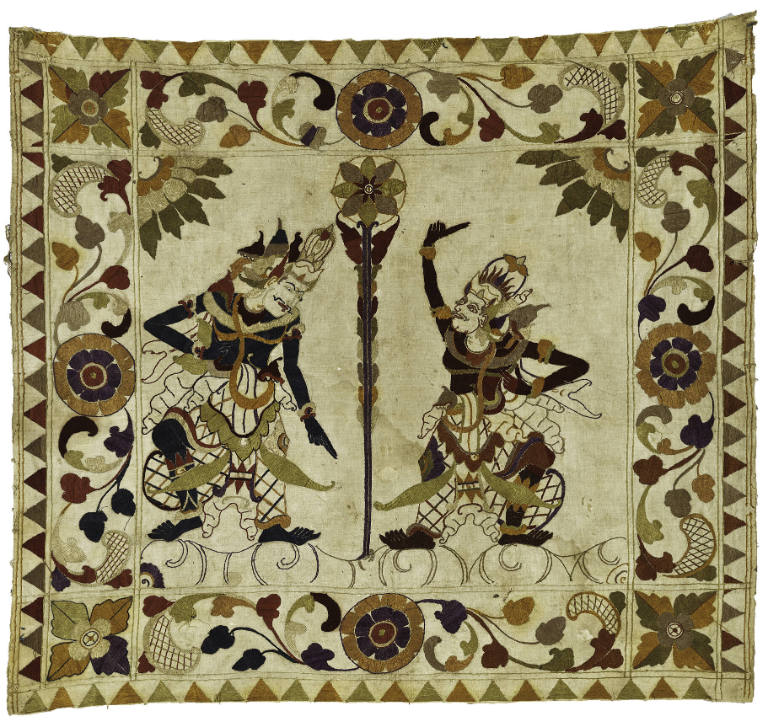
Rectangular hanging (tabing) showing Shiva sending down the lingga of indeterminate length, a scene from the Mahabharata
Dateca. 1960s or 1970s
MediumCotton embroidery on cotton cloth
Dimensions34 1/4 x 37 3/8 inches (87 x 95 cm)
CultureIndonesia, Bali, Negara
ClassificationsTextiles
Credit LineAcquired through the George and Mary Rockwell Fund
Terms
- Textiles
- Indonesian
- Cotton
- Gods
- Flowers
- Mahabharata
- Shiva
- Vishnu
- Brahma
- Hinduism
- Cloth
Object number2007.031.057
Label CopyThe myth of Linggodbawa (the erect Shiva-Lingga), originally comes from India and is retold in the Old Javanese prose work Korawasrama. A subject popular with Balinese painters and embroiderers alike, this tale involves a competition between the gods Brahma and Vishnu who dispute Shiva’s omnipotence and quarrel over which of the two are most powerful. Shiva is so provoked by their arrogance that he transforms himself into a magnificent phallus (lingga) in the shape of a pillar of fire that reaches to the sky, and that penetrates deeply into the earth below. Vishnu and Brahma make a futile attempt to destroy this enormous pillar-like object with their cakra and danda weapons, but in this embroidery, Vishnu (left) points (nuding) downward, while Brahma gestures ferociously upward.
Not depicted here is the next stage of the story where Visnu transforms into a wild boar, setting off to look for the bottom of the pillar, and Brahma transforms into an eagle and flies up into the sky to look for the tip. Neither are successful. On the way down, Vishnu turns himself into a boar. Along the way, he is distracted and aroused by the enchanting goddess of the earth, Pertiwi, and cannot restrain himself from copulating with her in his animal form. Pertiwi is so frightened that she gives birth to the demon, Kala Boma. After both gods fail, and Shiva emerges as the winner of the challenge, both beg forgiveness, and pay homage to him. This establishes the idea of Shiva as the center of the universe, and that the cardinal points are each protected by guard-gods which combine divine and demonic aspects within themselves.
Collections