

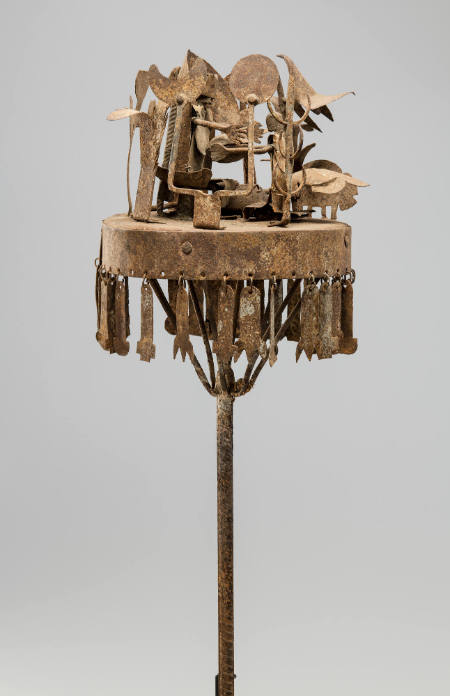
Altar (Asen)
MediumIron
Dimensions50 × 12 × 12 inches (127 × 30.5 × 30.5 cm)
CultureBenin, Fon peoples
ClassificationsMetalwork
Credit LineGift of Amyas Naegele, Class of 1978, and Eve Glasberg
Terms
- Bénin
- Metalwork
- Fon
- Iron
- Snakes
- Funerary objects
Object number2006.068.019
Label CopyBRIEF DESCRIPTION
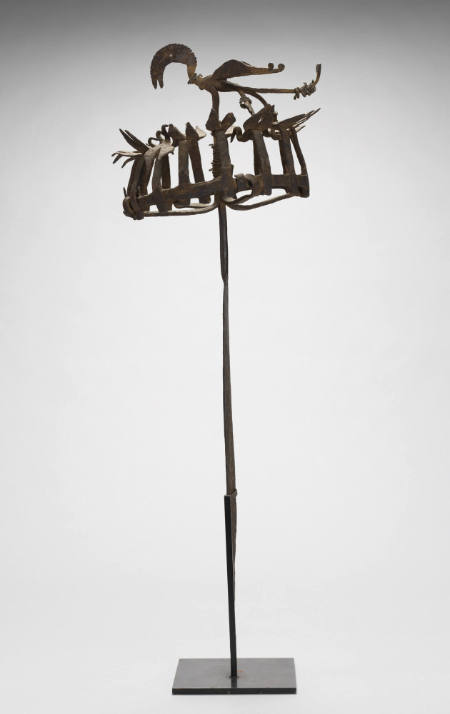
This is a commemorative altar, made to honor a particular Fon ancestor.
WHERE WAS IT MADE?
In the case of this Fon altar, the particulars of its style tell an informed eye what city it came from; this iron structure was made to honor a deceased Fon man from Ouidah, a city located near the coast of Benin in West Africa. Although altars similar in structure to this asen are made throughout southern Benin, the construction of this asen is unique to 20th-century Ouidah. Elsewhere, asen contain cast forms and figures, but only those made in Ouidah exclusively feature elements fashioned from cut iron. Ouidah asen are also known for their numerous figures and large, circular platforms.
HOW WAS IT MADE?
A blacksmith made this asen. To make the figures that you see on the top of the altar, he most likely cut or punched shapes from sheet metal and then hammered incised lines for added detail. Look at the base. Soldered to the platform are iron spokes, which gather together at a ball below, called a ko, and are then attached to the iron stake used to secure the asen in the ground. The blacksmith used rivets and bolts to attach the figures and decorative edges and objects that you see hanging from the sides of the platform.
HOW WAS IT USED?
This iron structure was made to honor a deceased Fon man from Ouidah, a city located near the coast of Benin in West Africa.
Although they were originally made for the exclusive use of the Fon elite, asens are now found within all social levels. In every Fon compound, there is a building called a dehoho, or family shrine. Within the building, asens honoring each deceased family member are stuck into the ground along with wooden figures called bocio (or bochio) that are covered with magical substances. To see a bocio in the Johnson Museum’s collection, search for object number 86.089.015 in the keyword search box.
At least once a year, the family “feeds” or honors the ancestors by offering drink, sacrificial libations such as animal blood, and finally food, to the asens. The family kneels and pays its respects to the spirits and then communes with them.
WHY DOES IT LOOK LIKE THIS?
Although altars similar in structure to this asen are made throughout southern Benin, the construction of this asen is unique to 20th-century Ouidah. Elsewhere, asen contain cast forms and figures, but only those made in Ouidah exclusively feature elements fashioned from cut iron.
Asen tableaux do not have a single corresponding meaning that is readily understood by a viewer. It is widely believed that only the maker and the family member who commissioned the asen fully comprehend its full significance. One constant, however, lies with the importance of the central, often seated, figure. He represents the deceased. The objects and figures that surround him may reference his occupation, his contributions to society or his family, or may simply be a playful pun of his name.
If you look at the central figure of this asen, you will see that he is seated on a stool and there is a calabash (gourd) laid before him. As a motif, a calabash regularly appears on asen. The calabash is the vehicle by which the living make offerings of food and water to the dead. The braided rope that curves over the calabash refers to the continuity of the ancestor’s lineage.
Notice the thick snake held aloft to the left of the seated man. This is the horned rainbow serpent, Dan Aido-huEdo. “Ni,” the Fon word for both rainbow and name, suggests that the serpent represents a pun. Planted in such a prominent place, it suggests the deceased’s personal resolve to honor the lineage name. The rainbow serpent may have further layers of significance: Dan connects thunder and the earth, thus transmitting souls to earth; and grants happiness and well-being to individuals.
The stalk from which tiny spikes protrude represents millet, a staple food in many parts of West Africa.
In the past, the pendants that dangle from the rim of the asen often served as the artisan’s personal signature. This form of identification is rarely practiced today; the pendants’ forms merely replicate a popular motif.
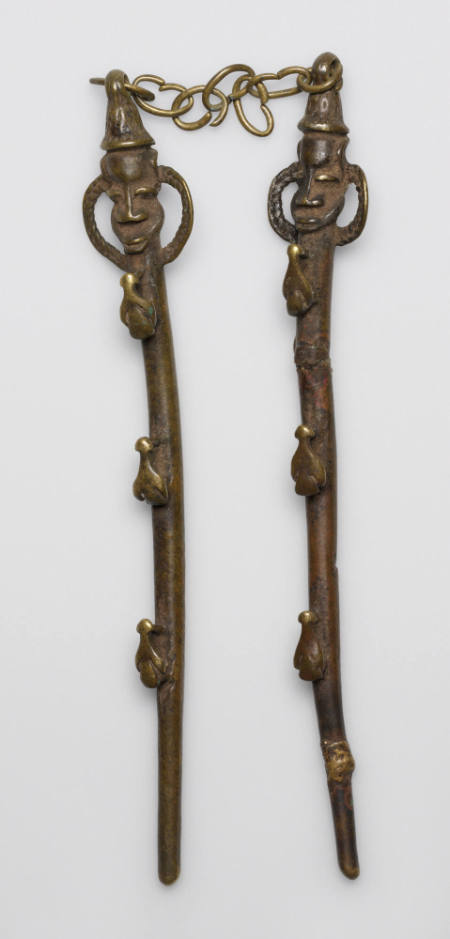
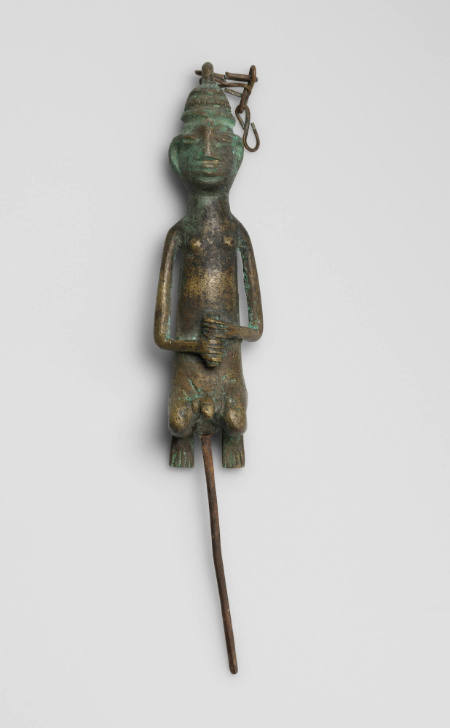
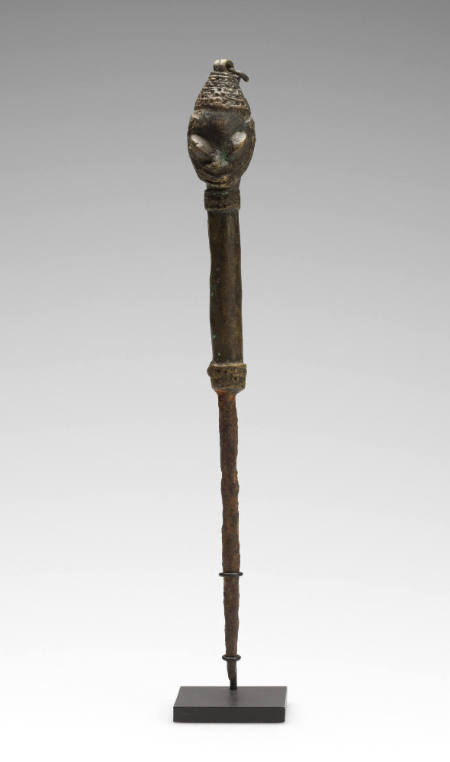
To see other Fon asen in the Johnson Museum’s collection, search for object numbers 99.092.020 and 2007.089.001 in the keyword search box.
Rebecca Shaffer ‘09 contributed to this entry.
Collections
AD 1200-1470
20th century
Maman Traore
ca. 1940–70