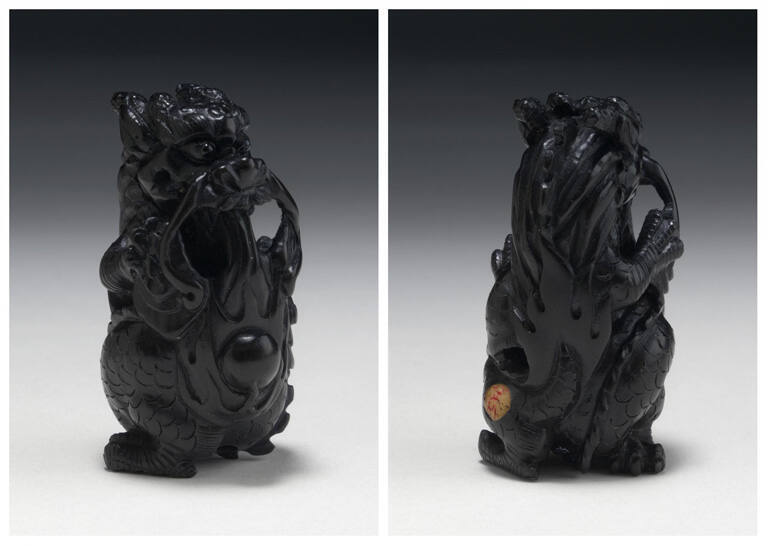
Netsuke in the form of a dragon
DateMeiji Period (1867-1912)
MediumCarved ebony wood, inlaid ivory, red ink
Dimensions2 1/4 x 1 3/16 x 7/8 inches (5.7 x 3 x 2.3 cm)
CultureJapanese
ClassificationsCostume
Credit LineGift of Drs. Lee and Connie Koppelman
Terms
- Costume
- Costume accessories
- Netsuke
- Japanese
- Carved ebony wood
- Inlaid ivory
- Red ink
- Animals
- Dragons
- Flames
- Mythological creatures
- Inscriptions
- Jewels
- Orbs
- Pearls
- Spheres
Object number99.073.025
Label CopyBRIEF DESCRIPTION
This is a wooden netsuke carved in the form of a dragon.
WHERE WAS IT MADE?
This netsuke was made in Japan.
HOW WAS IT MADE?
Netsuke made from wood, like this one, were hand-carved with knives, chisels and files of different sizes. This netsuke was carved from ebony, a very hard, black wood.
HOW WAS IT USED?
During the Edo period (1603-1868), the standard attire for a well-dressed Japanese man consisted of a kimono tied with a sash. Because kimonos had no pockets, accessory bags and carrying cases (called sagemono: hanging things) were used to hold personal items such as money, medicines, tobacco and seals (a stamp carved with the owner’s name). Silken cords, attached to the sagemono, were threaded through the kimono sash (obi). A toggle, called a netsuke, was attached to the other end of the cord to prevent it from slipping through the sash. To see a netsuke with an inro—one popular type of sagemono that consisted of small, stacked compartments for holding medicines—search for object number 98.087.006 in the keyword search box.
The term netsuke comes from the words ne, meaning ‘root’ and tsuke, meaning ‘to fasten.’ Early netsuke may have been made from found objects such as pieces of roots, nuts, coral and bone. Over time, netsuke production became more and more varied, refined, and innovative, reaching a high point in the early 19th century. Subjects and decoration of netsuke and sagemono reflected the tastes and aspirations of their owners, often infused with an element of comic irony. As clothing traditions modernized, netsuke came to be collected separately from sagemono, and appreciated as sculptural gems in their own right.
WHY DOES IT LOOK LIKE THIS?
The Chinese calendar follows a sixty-year cycle, broken into five twelve-year units. Each of the twelve years is associated with an animal. The day is also divided into twelve periods, each associated with one of the twelve animals. The animals associated with the year and the hour of one’s birth have long been used in some Asian countries to predict one’s character and personality traits. The animals of the zodiac became popular subjects for netsuke during the 19th century, as people became interested in purchasing netsuke depicting the animal associated with their birth year, as well as building collections of all twelve animals. The twelve animals are rat, ox, tiger, rabbit, dragon, snake, horse, goat, monkey, rooster, dog and pig.
The dragon is associated with water and rain—it is a nourishing, beneficial creature, rather than fearsome. In the zodiac, it is associated with qualities such as vigor, dignity, nobility and loyalty.
One of the Buddha’s disciples, known in Japan as Handaka Sonja, keeps a dragon in a bowl or a bottle. In this painting in the Johnson Museum’s collection, the dragon is shown in a cloud that emerges from Handaka Sonja’s bowl; to see the painting, search for object number 95.004 in the keyword search box.
To compare this wooden netsuke of a dragon with an ivory netsuke also carved in the form of a dragon, search for object number 73.005.190 in the keyword search box.
Collections



18th century