

Layla’s letter is delivered to Majnun, page from a Khamsa of Nizami,
Artist
Unidentified artist
Date16th century
MediumOpaque watercolors and gold on paper
DimensionsImage: 8 1/2 × 5 7/8 inches (21.6 × 14.9 cm);
Sheet: 11 3/8 × 5 7/8 inches (28.9 × 14.9 cm)
Sheet: 11 3/8 × 5 7/8 inches (28.9 × 14.9 cm)
CultureIran
PeriodSafavid period
ClassificationsPaintings
Credit LineGift of Professor M. H. Abrams, in honor of Frank Robinson
Terms
- Paintings
- Persian
- Opaque watercolor
- Gold
- Trees
- Goats
- Clouds
- Paper
Object number2011.007.018
Label CopyThis page is from section 35 of Nizami’s Khamsa. In this scene Majnun, who has been living in the desert with animals and feeding on plants, has become thin and weak due to the sadness of his separation from Layla. On the right side of the painting, we see a messenger who has brought a letter from Layla. Overcome with emotion, Majnun fainted while holding the letter in his hand, and then he regained consciousness.
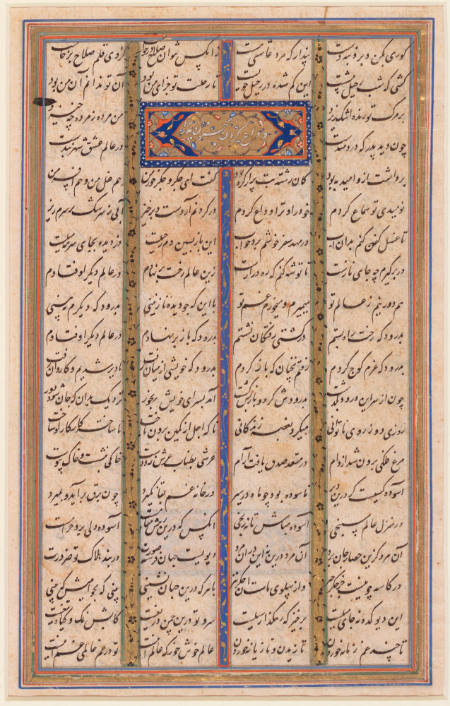
Based on Nizami’s poem on this page, the letter began with the name and description of God. Then Layla wrote of the sadness of love and likened her letter to a bird sent by a sad person to a person in pain. “This letter should go from me, who is imprisoned in a cage, to you, who has broken the cage door and is now free. We have to be patient with what the world and time have asked of us. Don't be sad if no one is with you. Am I not enough for you?”
When Majnun read Layla’s letter, he felt refreshed, like a bud opening into a blossom. He called on God and cried for hours. Then he kissed the messenger’s hand and foot. Majnun immediately wrote a letter in reply to express his own sorrow, then gave the letter to the messenger. The messenger left with the speed of the wind to deliver Majnun’s letter to Layla.
Collections

Unidentified artist
late 18th or early 19th century

Unidentified artist
1665–80
Unidentified artist
ca. 1595
Unidentified artist
14th century
Unidentified artist
late 18th century