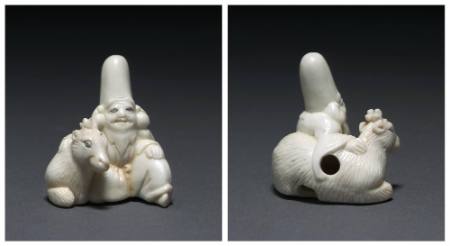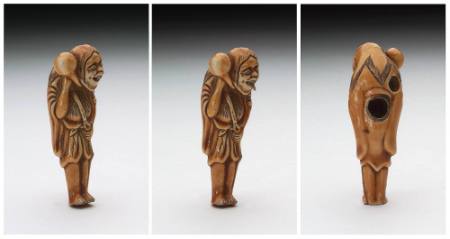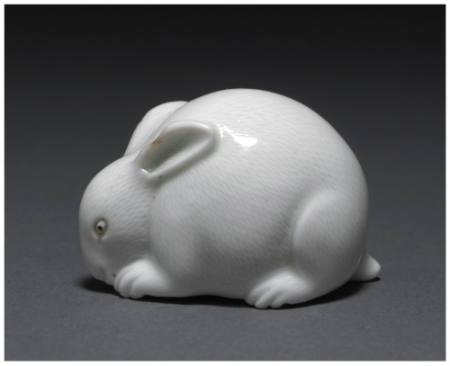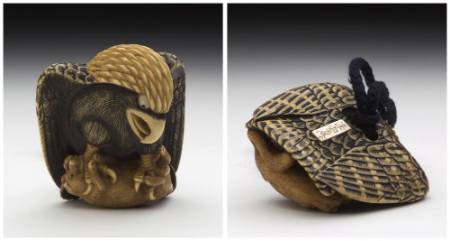

Jurojin, Hirato ware
Maker
Unidentified artist
Date19th century
MediumPorcelain, brown glaze, black ink
Dimensions3/4 x 3/4 x 2 1/4 inches (1.9 x 1.9 x 5.7 cm)
CultureJapanese
ClassificationsCostume
Credit LineGift of Carl A. Kroch, Class of 1935
Terms
- Ceramics
- Costume
- Sculpture
- Costume accessories
- Netsuke
- Japanese
- Black ink
- Brown glaze
- Porcelain
- Beards
- Daoism
- Fans (costume accessories)
- Folklore
- Gods
- Heads (representations)
- Jurojin
- Religion
- Shou Lao
- Taoism
- Walking sticks
Object number87.048.054
Label CopyBRIEF DESCRIPTION
This is a porcelain netsuke in the form of Jurojin, a Japanese god of longevity.
WHERE WAS IT MADE?
This netsuke was made in Japan.
HOW WAS IT MADE?
Netsuke made from porcelain, like this one, were hand-modeled from a white clay containing kaolin, then glazed and fired in a kiln.
HOW WAS IT USED?
During the Edo period (1603-1868), the standard attire for a well-dressed Japanese man consisted of a kimono tied with a sash. Because kimonos had no pockets, accessory bags and carrying cases (called sagemono: hanging things) were used to hold personal items such as money, medicines, tobacco and seals (a stamp carved with the owner’s name). Silken cords, attached to the sagemono, were threaded through the kimono sash (obi). A toggle, called a netsuke, was attached to the other end of the cord to prevent it from slipping through the sash. To see a netsuke with an inro—one popular type of sagemono that consisted of small, stacked compartments for holding medicines—search for object number 98.087.006 in the keyword search box.
The term netsuke comes from the words “ne”, meaning ‘root’ and “tsuke”, meaning ‘to fasten.’ Early netsuke may have been made from found objects such as pieces of roots, nuts, coral and bone. Over time, netsuke production became more and more varied, refined, and innovative, reaching a high point in the early 19th century. Subjects and decoration of netsuke and sagemono reflected the tastes and aspirations of their owners, often infused with an element of comic irony. As clothing traditions modernized, netsuke came to be collected separately from sagemono, and appreciated as sculptural gems in their own right.
WHY DOES IT LOOK LIKE THIS?
Notice that this figure has an especially tall head, and is carrying a staff. In another hand he carries a fan. These are all attributes common to the God of Longevity, one of the Seven Gods of Good Fortune. His large head may be a sign of his accumulated wisdom.
Collections