

Art Nouveau frame and mirror
Artist
Hermann Hausmann
(1865–1902)
Date1902
MediumBronze and glass
Dimensions13 x 10 inches (33 x 25.4 cm)
ClassificationsDecorative Arts
Credit LineGift of Isabel and William Berley, Classes of 1947 and 1945
Terms
- Decorative Arts
- Mirror
- French
- Bronze
- Women
- Flowers
- Plant-derived motifs
Object number99.078.109
Label CopyBRIEF DESCRIPTION
This mirror has an Art Nouveau pattern bronze frame, featuring a woman’s face at the bottom and lily pads along the top.
WHERE WAS IT MADE?
This mirror was likely made in Berlin, Germany, where the sculptor Hermann Hausmann did most of his work.
HOW WAS IT MADE?
This mirror features a molded bronze frame. Molding is a process of manufacturing that involves shaping a pliable or liquid material into a rigid frame or model called a mold. When the liquid (in this case, bronze) hardens it is removed, revealing a positive of the negative space of the mold.
WHY DOES IT LOOK LIKE THIS?
This bronze mirror is very typical of the French Art Nouveau style. Notice the female face with eyes closed at the bottom edge; her hair encircles the frame, transforming into water lilies and the slender stems of lily pads that float at the top of the frame. The lines of the composition are wavy and undulating, and are typical of imagery found in other decorative arts objects of the period.
Art Nouveau, French for “New Art,” refers to an artistic style that was developed in Europe in the 1880s, and remained enormously popular into the first decade of the 20th century. It is characterized by whiplash curves, organic imagery and sinuous lines. The name Art Nouveau came from the Paris shop of Siegfried Bing that opened in 1895, quickly popularizing the works of artists like Louis Comfort Tiffany, whose work became synonymous with (or symbolic of) the American Art Nouveau style.
Collections
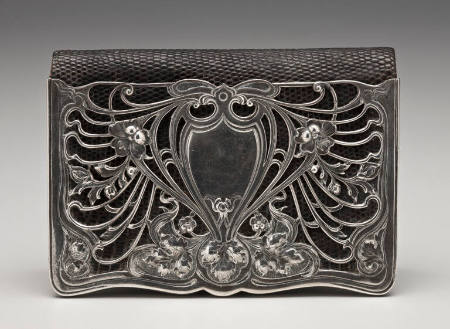
ca. 1900
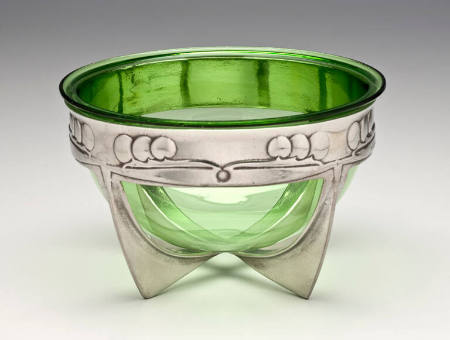
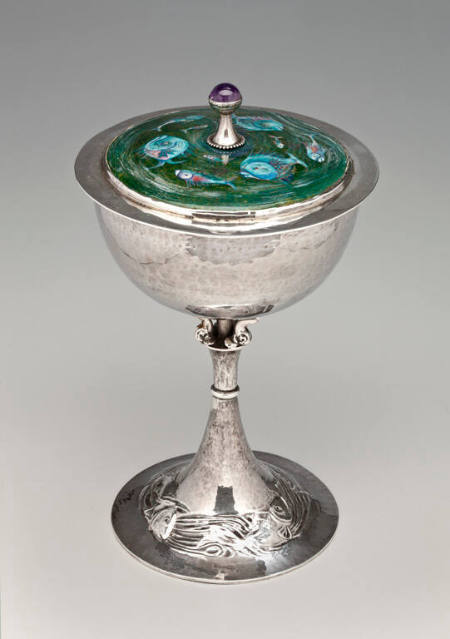

late 19th–early 20th century
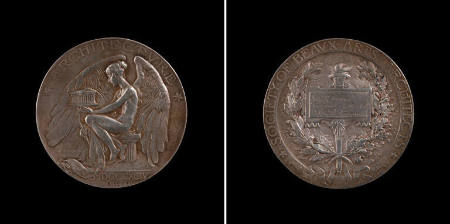

Unidentified artist