
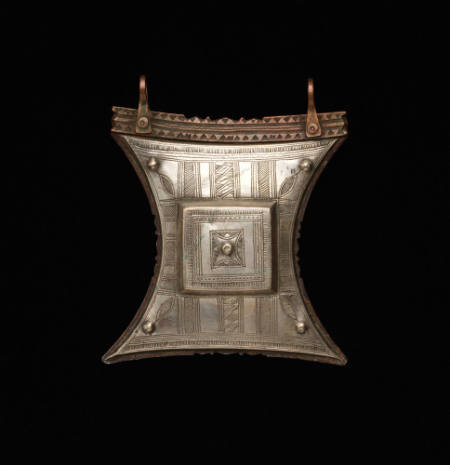
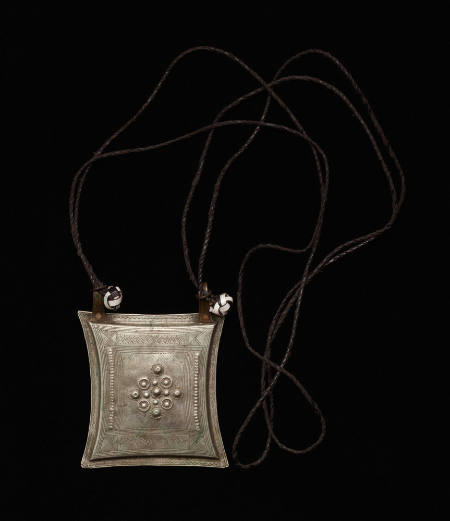
Necklace (tadne or tadnet)
MediumSilver and black glass beads
Dimensions16 1/2 x 2 1/8 x 1/4 inches (41.9 x 5.4 x 0.6 cm)
CultureTuareg (Western Sahara and Northwestern Sudan)
ClassificationsMetalwork
Credit LineGift of Amyas Naegele, Class of 1978
Terms
- Metalwork
- Tuareg
- Jewelry - Necklaces
Object number99.092.027
Label CopyBRIEF DESCRIPTION
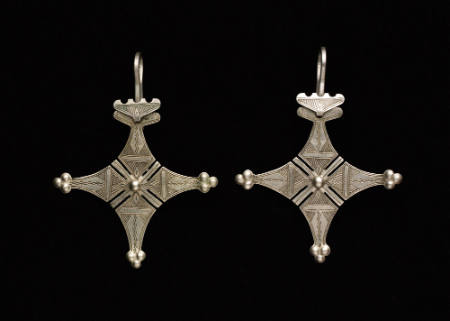
Although both men and women wear amulets, only women wear this tadnet as an adornment. The cross formation does not carry religious meaning; Tuareg forms and patterns typically do not represent anything in nature, nor do they carry religious significance.
WHERE WAS IT MADE?
Until very recently, Tuareg peoples lived a nomadic lifestyle, trading and raising cattle around the western Sahara and northwestern Sudan.
HOW WAS IT MADE?
Blacksmiths make all silver jewelry and leatherwork among the Tuareg. Regarded by the class-based Tuareg as racially and culturally inferior, members of the blacksmith caste nevertheless hold some power in the community. The Tuareg, along with many other African cultural groups, believe that blacksmiths have mystical powers and a special relationship to the elements that allow them to work with fire and earth (metals). With these powers they enjoy special privileges and a certain esteem in the community, but are not regarded by the Tuareg as equals.
HOW WAS IT USED?
As a result of their itinerant way of life, Tuareg wealth and arts must be movable. Wealth is concentrated in cattle and jewelry, such as this necklace. Other arts valued among the Tuareg such as poetry, music, and dance, create no material culture that must be carried.
WHY DOES IT LOOK LIKE THIS?
Most Tuareg material culture is symmetrical and non-symbolic. The cross formation of this necklace does not carry religious significance.
Collections
mid 20th century
mid-20th century