
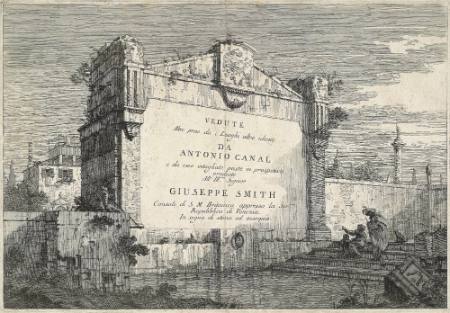
The Left Half of the Fantastic View of Venice—The House with the Inscription MDCCXLI AC
Artist
Antonio Canaletto
(Italian, 1697–1768)
Date1741
MediumEtching on laid paper
DimensionsPlate: 11 7/8 × 8 9/16 inches (30.2 × 21.7 cm);
Sheet: 14 3/8 × 10 1/8 inches (36.5 × 25.7 cm)
Sheet: 14 3/8 × 10 1/8 inches (36.5 × 25.7 cm)
ClassificationsPrints
Credit LineBequest of William P. Chapman, Jr., Class of 1895
Terms
- Italian
- Etching
- Houses
- Streetscapes
- Urban views
- laid
Object number57.157
Label CopyWhile Canaletto’s paintings almost always depicted well known Venetian landmarks, as befitting their status as more formal works commissioned by foreign collectors, Canaletto seems to have turned to etching his own plates in the 1740s in part because of the freedom provided by printmaking to experiment with so-called vedute ideate, or ideal views. These views balance the topographical fidelity he had practiced for decades with a fanciful recombination of disparate landscapes and schools of architecture. The two halves of this composition originally began their lives as a single plate; no more than a few impressions from the whole plate are known today. Taken together or separately, they show Canaletto’s adept, amusing blending of Venetian and Roman architectural idioms, as seen in the Venetian palace with its columned portico in the right half of the composition, and his juxtaposition of the hilly terrain of Rome with the sea-level skyline and boat-populated waterways reminiscent of Venice, as seen in both halves of the scene. (Andrew C. Weislogel, "Mirror of the City: The Printed View in Italy and Beyond, 1450–1940," catalogue accompanying an exhibition organized by the Herbert F. Johnson Museum of Art, curated by Andrew C. Weislogel and Stuart M. Blumin, and presented at the Johnson Museum August 11–December 23, 2012)
Collections
![Vue Fantastique de San Giacomo di Rialto [Fantastic View of San Giacomo di Rialto]](/internal/media/dispatcher/69349/thumbnail)
Antonio Canaletto
ca. 1740 - 1746
![Le Marché sur le Mole [Market on the Mole]](/internal/media/dispatcher/69353/thumbnail)
![La Villa au de lá d'une riviére [The Market at Dolo]](/internal/media/dispatcher/69345/thumbnail)

Israël Silvestre

Giovanni Battista Piranesi
1774