
Red Lustre Bowl with Crackle Effect
Artist
Louis Comfort Tiffany
(American, 1848–1933)
Dateca. 1921
MediumGlass
DimensionsHeight: 1 3/4 inches (4.4 cm);
Diameter: 5 3/4 inches (14.6 cm)
Diameter: 5 3/4 inches (14.6 cm)
ClassificationsDecorative Arts
Credit LineGift of Louis Comfort Tiffany through the courtesy of A. Douglas Nash
Terms
- Decorative Arts
- Glassware
- Vessels - Bowls
- American
- Glass
Object number57.097
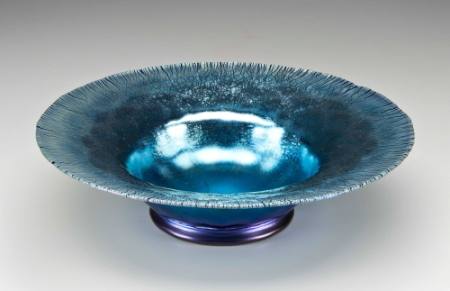
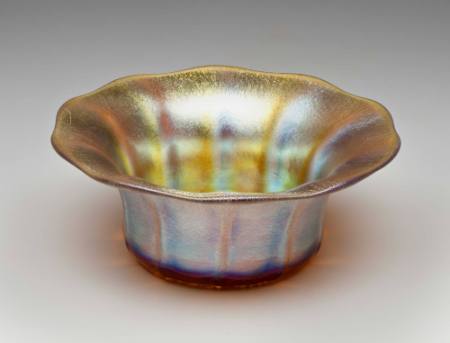
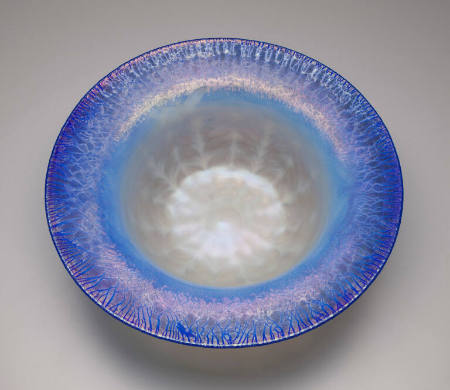
Label CopyBRIEF DESCRIPTIONThis small Tiffany bowl features a metallic red luster on the inside as well as deep blue-green around the footed base. Notice the crackled effect around the outer edge.
WHERE WAS IT MADE?
Tiffany glass was made at the Tiffany Glass Furnaces in Corona, located in Queens, New York.
WHO WAS THE ARTIST?
Louis Comfort Tiffany was the eldest son of Charles L. Tiffany, founder of Tiffany & Company, the New York jeweler. Tiffany was trained as a painter, studying with both George Inness and Samuel Coleman in New York and Leon Bailly in Paris. He eventually turned his attention to decorative arts and began experimenting with glass-making techniques in 1875. After success with stained glass windows and mosaics, Tiffany established the Tiffany Glass Company in 1885 and began devoting production to one-of-a-kind blown glass art objects. He soon became one of America’s most prolific designers, providing furniture, wallcoverings, textiles, jewelry and glass to some of society’s most important citizens.
HOW WAS IT MADE?
The shimmering iridescence on this bowl is a decorative effect achieved by introducing metallic substances into the batch or by spraying the surface of the vessel with oxides like stannous chloride or lead chloride and then reheating it in a reduced (oxygen deprived) atmosphere. Ancient glass often has an iridescent appearance caused by the effects of weathering.
The crackle effect on this bowl is achieved by spraying the surface with oxides or metallic substances and then reheating it, similar to the process used to achieve an iridescent effect.
WHY DOES IT LOOK LIKE THIS?
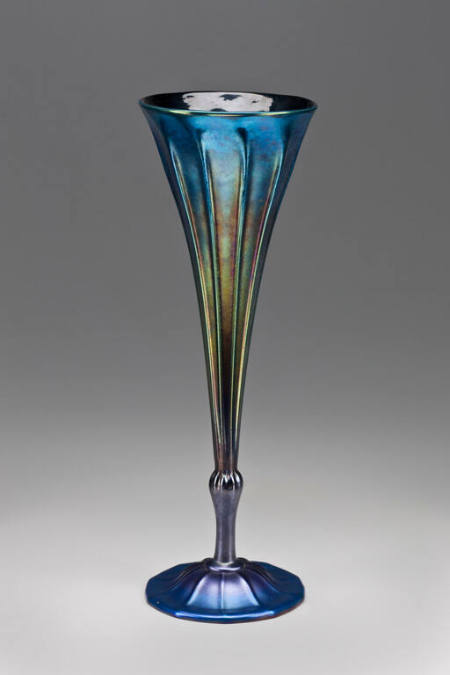
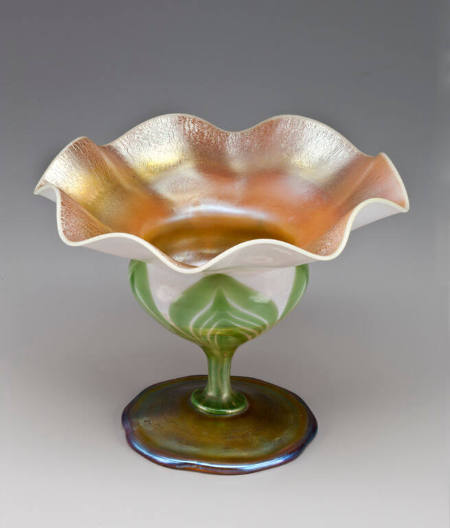
This bowl is an example of Tiffany’s Favrile glass. In 1894, Tiffany patented his iridescent glass under the name Favrile. The word Favrile is derived from the Old English fabrile, meaning hand-wrought. Inspired by glass from ancient Rome and the Islamic world, Venice and Bohemia, Tiffany glassmakers copied many of the colors, texture, decoration and unique forms made long ago. Tiffany combined his talent as a colorist, naturalist, and designer with his experimentations on blown glass surfaces. Vessels were fumed with metallic oxides before firing to achieve the same iridescence found on ancient glass. To see an example of ancient glass in the Johnson Museum’s collection, search for object number 57.109 in the keyword search box.
To see other examples of Tiffany’s Favrile glass in the Johnson Museum’s collection, search for object numbers 57.072, 57.080, 57.088, 57.106, 64.0840, 64.0841, 64.0842, 64.0843, 64.0850, 64.0865, 64.0875, 64.0879, 64.0885, 64.0889, 64.0898, 64.0904, 99.078.118 a,b, and 2001.075.003 in the keyword search box.
Collections